Re-order Paragraphs is one of those PTE Reading tasks that can feel annoying because the options often look almost right. You might understand every sentence, but still get stuck trying to decide between two “possible” orders.
Here’s the truth: this task isn’t about reading every sentence deeply. It’s about spotting patterns—like how sentences naturally link using topic sentences, pronouns, and transition words. Once you train your eyes to notice those signals, the question becomes much easier (and faster).
I’ll walk you through a simple strategy I teach students aiming for 65–79+. It works even if you feel you’re “not good at reading,” because it relies more on structure than vocabulary.
Why Re-order Paragraphs Is Tricky (And Why That’s Good News)
PTE doesn’t test you with random sentences. The paragraphs are written like normal academic writing, which means:
- ideas introduce a topic, then expand it
- pronouns refer back to nouns
- connectors show cause, contrast, or addition
- examples come after claims
So even when you’re stuck, the passage always contains clues. Your job is to stop guessing and start using those clues like a system.
The 3 Clues That Solve Most Re-order Paragraphs Questions
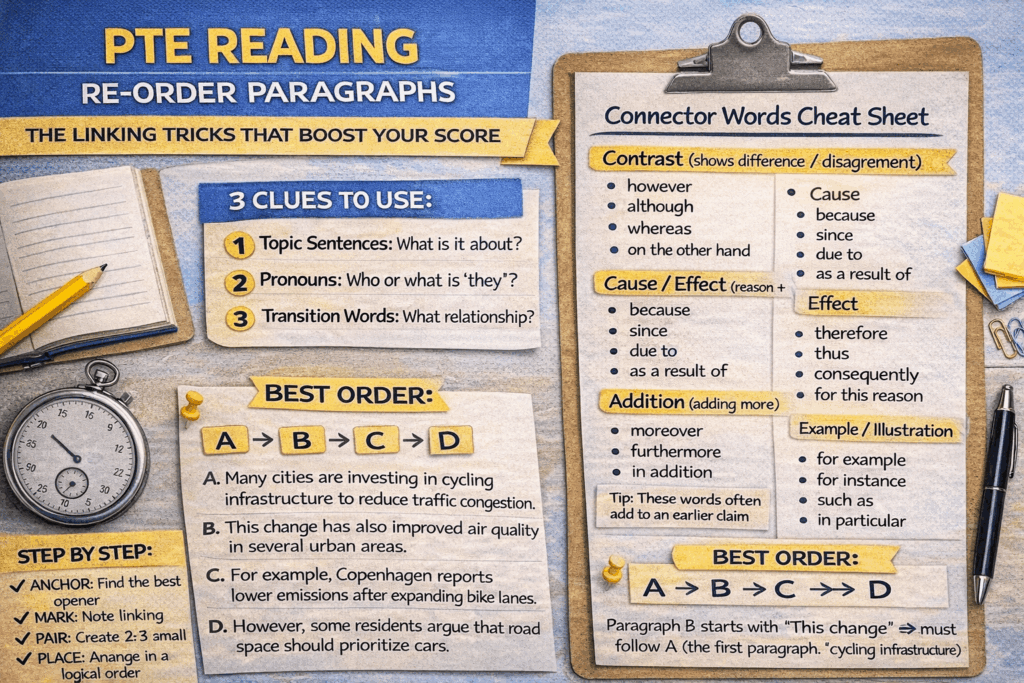
1) Topic sentences: “What is this paragraph about?”
A topic sentence often:
- introduces a broad idea
- feels like the start of a new section
- doesn’t use “this/these/they” without explaining what those are
Example topic-sentence signals:
- “Many students struggle with…”
- “One major reason for…”
- “In recent years, researchers have found…”
If a paragraph starts with a definition or a broad statement, it’s more likely to be early in the order.
2) Pronoun references: “Who/what is ‘they’?”
Pronouns are one of the easiest linking tools:
- this / these → refer to something mentioned earlier
- it / they / them / their → must have a clear noun before it
- such → usually refers to a specific example previously introduced
If you see a paragraph start with “This” or “These,” it almost never belongs at the very beginning, because “this” needs a reference.
3) Transition words: “What relationship is being shown?”
Transition words tell you whether the writer is:
- continuing an idea
- contrasting it
- giving a cause/result
- adding another point
- providing an example or conclusion
You can often place paragraphs just by reading the first one or two lines and spotting transitions.
Step-by-step Strategy (The “Anchor + Link” Method)
Here’s the method that prevents you from staring at the screen too long:
Step 1: Find the “anchor” paragraph (the best opener)
Look for the paragraph that:
- introduces the topic clearly
- does not rely on pronouns like “this/they”
- feels broad, not specific
This becomes your starting point.
Step 2: Mark “linking words” at the start of each paragraph
Quickly scan the first sentence of each paragraph and note:
- pronouns (“this”, “they”, “it”)
- connectors (“however”, “therefore”, “in addition”)
- example markers (“for example”, “such as”)
Don’t overthink. You’re just gathering clues.
Step 3: Pair paragraphs using “strong links”
Now build small pairs:
- a paragraph mentioning “these problems” → must follow something describing problems
- a paragraph starting “however” → must follow a paragraph with an idea to contrast
- a paragraph using “for example” → must follow a general claim
Create pairs first. Once you have 2–3 pairs, the full order usually appears quickly.
Step 4: Check logic: general → specific → result
A common academic flow is:
Topic → Explanation → Example → Result/Conclusion
If you see a paragraph full of details, numbers, or examples, it probably belongs later.
Step 5: Final confirmation (read as a mini-article)
When you have an order, read the transition between paragraphs:
- Does it feel natural?
- Does each pronoun have a clear reference?
- Do contrast words contrast something real?
If yes, lock it.
Connector Words Cheat Sheet (Grouped by Function)
These words are like signposts. If you train yourself to notice them, you’ll place paragraphs faster.
Contrast (shows difference / disagreement)
- however
- although
- whereas
- in contrast
- on the other hand
- nevertheless
- yet
- despite this
Tip: Contrast paragraphs almost always come after a paragraph that states the opposite idea.
Cause / Effect (reason + result)
Cause:
- because
- since
- due to
- as a result of
- therefore (often result, but points to reasoning)
Effect:
- therefore
- thus
- consequently
- as a result
- this leads to
- for this reason
Tip: “Therefore/As a result” paragraphs usually come after a paragraph explaining why.
Addition (adding another point)
- moreover
- furthermore
- in addition
- also
- additionally
- another reason
- similarly
Tip: Addition connectors often come after the main idea is already introduced.
Example / Illustration (shows support)
- for example
- for instance
- such as
- in particular
- to illustrate
- including
Tip: Example paragraphs usually follow a general statement.
Time / Sequence (order of steps)
- first
- then
- next
- finally
- previously
- later
Tip: Sequence words can lock the order very quickly.
Worked Example 1 (4 sentences) — Using Pronouns + Topic Sentence
Paragraph A: “Many cities are investing in cycling infrastructure to reduce traffic congestion.”
Paragraph B: “This change has also improved air quality in several urban areas.”
Paragraph C: “For example, Copenhagen reports lower emissions after expanding bike lanes.”
Paragraph D: “However, some residents argue that road space should prioritise cars.”
Reasoning (quick):
- A is the best opener: introduces topic clearly.
- B starts with “This change” → must follow A.
- C is an example → supports the claim in B/A.
- D starts with “However” → contrast comes after the positive points.
✅ Best order: A → B → C → D
Worked Example 2 (4 sentences) — Using Transition Words
Paragraph A: “Online learning can be effective when courses are well designed.”
Paragraph B: “However, students often struggle without clear guidance.”
Paragraph C: “For this reason, many platforms now include tutor support.”
Paragraph D: “In addition, regular feedback helps learners stay motivated.”
Reasoning (quick):
- A introduces main idea.
- B contrasts it (“However”) → follows A.
- C shows result (“For this reason”) → follows the problem in B.
- D adds another supporting point (“In addition”) → comes after C.
✅ Best order: A → B → C → D
Troubleshooting: When Two Options Look Right
This is the part that gets most people. Here’s what to do when you’re stuck between two possible orders:
1) Check pronoun clarity
Ask: Does every “this/they/it” clearly refer to something before it?
If not, that order is wrong.
2) Look for “example after claim”
If one paragraph says “for example” but you haven’t seen the general claim yet, it’s misplaced.
3) Check the “however” test
“However” must contrast something. If it comes too early, it feels weird.
If “however” follows a paragraph that isn’t stating a clear idea, it’s probably wrong.
4) Use the “narrowing rule”
Academic writing usually goes from:
general idea → specific details
If one paragraph is very specific, it likely belongs later.
5) Read only the first line of each paragraph again
When you’re stuck, don’t reread the full paragraphs. Re-read the first line and focus on connectors/pronouns. That’s where the puzzle clues live.
If You Only Remember One Thing…
If you only remember one thing, remember this:
Don’t try to “understand everything.” Try to “link everything.”
Re-order Paragraphs is a linking task. Your score improves when you stop reading like it’s a normal article and start spotting structure like a puzzle.
Quick Practice Tip (5 minutes a day)
Take any short article and do this:
- cover the paragraphs
- read only the first sentences
- guess the order based on connectors and pronouns
It trains the exact skill you need for this task.