
PTE Reading Fill in the Blanks: The Vocabulary Trick Most Students Ignore
Reading Fill in the Blanks (FIB) looks simple on the surface: you read a passage, choose the best word for each blank, and move on. But if you’ve practiced this task, you already know the problem—two options often look “kind of right.” That’s where students lose marks.
Here’s the vocabulary trick most students ignore:
Stop choosing words based on meaning alone. Start choosing words based on collocations + grammar.
A collocation is a “natural word pair” in English—words that commonly go together, like:
- make a decision (not do a decision)
- heavy rain (not strong rain)
- take responsibility (not get responsibility)
PTE loves collocations because they test real language use, not just dictionary meaning. If you learn to spot them, your accuracy jumps fast—even without memorizing thousands of words.
Why Collocations Matter in PTE FIB
In PTE Reading FIB, the test isn’t just checking if you know the meaning of a word. It’s checking:
- does this word fit the grammar of the sentence?
- does it sound natural in academic English?
- does it “pair correctly” with the words around it?
That last point is collocation.
Example:
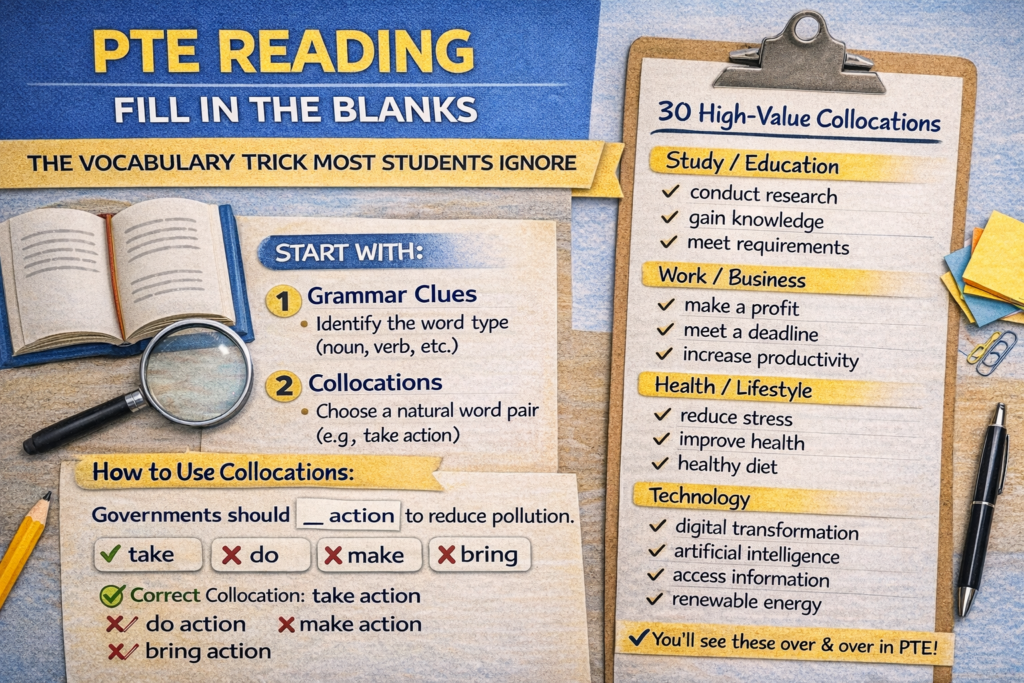
“Governments should ___ action to reduce pollution.”
You might see options like: take / do / make / bring
All four have similar meaning, but only one collocates naturally:
✅ take action
❌ do action
❌ make action
❌ bring action
This is why students who rely only on meaning get stuck.
The Winning Method: Grammar Clues + Collocation
Here’s the simple coach-style approach I teach:
Step 1: Identify the grammar role of the blank
Before you even look at options, ask:
- Do I need a noun? (policy, decision, impact)
- Do I need a verb? (reduce, improve, measure)
- Do I need an adjective? (significant, rapid, reliable)
- Do I need an adverb? (clearly, sharply, widely)
Quick trick: look at the word right before and right after the blank.
“a ___ result” → adjective (a positive result)
“to ___ costs” → verb (to reduce costs)
“an increase in ___” → noun (increase in demand)
This alone eliminates half the options.
Step 2: Use collocation to choose the “natural” fit
Now that you know the word type, test collocation:
- Does this word commonly go with the next word?
- Does it match academic writing style?
- Does it “sound right” in English?
Even if two options are grammatically possible, collocation usually reveals the correct one.
Step 3: Confirm by reading the full sentence
Read the sentence once with your chosen word. If it feels smooth and clear, move on. Don’t overthink.
30 High-Value Collocations (Grouped by Themes)
Below are 30 collocations that appear all the time in PTE-style reading passages. Learn these and you’ll notice your FIB accuracy improve quickly.
1) Study / Education (6)
- conduct research
- academic performance
- gain knowledge
- meet requirements
- take an exam
- attend lectures
2) Work / Business (6)
- make a profit
- meet a deadline
- take responsibility
- increase productivity
- business strategy
- job satisfaction
3) Health / Lifestyle (6)
- reduce stress
- improve health
- mental health
- healthy diet
- seek treatment
- medical condition
4) Technology (6)
- digital transformation
- data privacy
- artificial intelligence
- access information
- technical support
- system failure
5) Environment (6)
- climate change
- reduce pollution
- renewable energy
- natural resources
- carbon emissions
- environmental impact
Tip: Don’t just memorize the list. Try using them in short sentences. That’s how they become “automatic” in your head.
How to Apply This in Real PTE Reading FIB
Let’s combine the method with an example process (not a full long passage—just the thinking):
Sentence: “The new policy aims to ___ pollution and protect public health.”
Step 1: Blank is after “to” → needs a verb.
Step 2: Options might include: reduce / decline / decrease / remove
Step 3: Collocation check: ✅ “reduce pollution” is the strongest and most common academic collocation.
Pick reduce and move.
This takes seconds when trained.
Common Traps Students Fall For (Avoid These)
Here’s what I see students do wrong most often:
- Choosing words by meaning only, ignoring collocation
- Forgetting to check word type (noun/verb/adjective)
- Picking a word that fits one part of the sentence but breaks the next part
- Overthinking and changing a correct answer
- Not learning common academic collocations (they repeat constantly)
If you fix just one thing: always decide the word type first.
7-Day Mini Practice Challenge (15–20 minutes/day)
You don’t need a huge study plan to get better at FIB. You need repetition in the right way.
Day 1: Collocation awareness
- Learn 10 collocations (any theme)
- Write 1 sentence for each
Day 2: Word type speed drill
- Take 10 random sentences (news article is fine)
- Mark each blank as noun/verb/adjective/adverb (no options needed)
Day 3: FIB practice (focus on elimination)
- Do 2 Reading FIB questions
- For every blank: write “noun/verb/adj/adv” before selecting
Day 4: Collocation building
- Learn 10 more collocations
- Speak them aloud (yes, speaking helps memory)
Day 5: FIB practice (collocation focus)
- Do 2–3 FIB questions
- After choosing each word, quickly ask: “What word does this pair with?”
Day 6: Review mistakes
- Re-do the FIB questions from Day 3 and Day 5
- Note which blanks confused you and what collocation you missed
Day 7: Speed round
- Do 3 FIB questions timed
- Aim for smooth, confident choices—not perfect analysis
If you do this for one week, you’ll start seeing the same collocations show up again and again. That repetition is what boosts your score.
Final Coach Tip
FIB isn’t a vocabulary test where you need advanced words. It’s a natural English usage test. Students who score well aren’t always the ones with the biggest vocabulary—they’re the ones who know what sounds correct in real academic English.
If you want, try your next mock test and focus only on this:
- decide the word type
- check collocation
- confirm quickly and move on
That alone can lift your Reading score without extra study hours.