Write From Dictation (WFD): The Most Efficient Way to Lift Your PTE Score
If you asked me to pick the single most important task in the entire PTE exam, I wouldn’t hesitate for a second. It is Write From Dictation (WFD).
I have spent years coaching hundreds of students, and I’ve seen this pattern over and over: a student works themselves to the bone on essays and reading, but their score refuses to budge. The moment we sit down and fix their WFD strategy, they jump from a 60 to a 79+ almost instantly. In the world of PTE, WFD is the king of “Return on Investment.” It appears at the very end of your Listening test, and it carries massive weight for both your Listening and Writing scores.
Why WFD is Your Secret Weapon
Most test-takers make the mistake of thinking WFD is just a simple “hearing” test. It’s not. It is actually a test of your short-term memory, your typing accuracy, and your mastery of English sentence patterns.
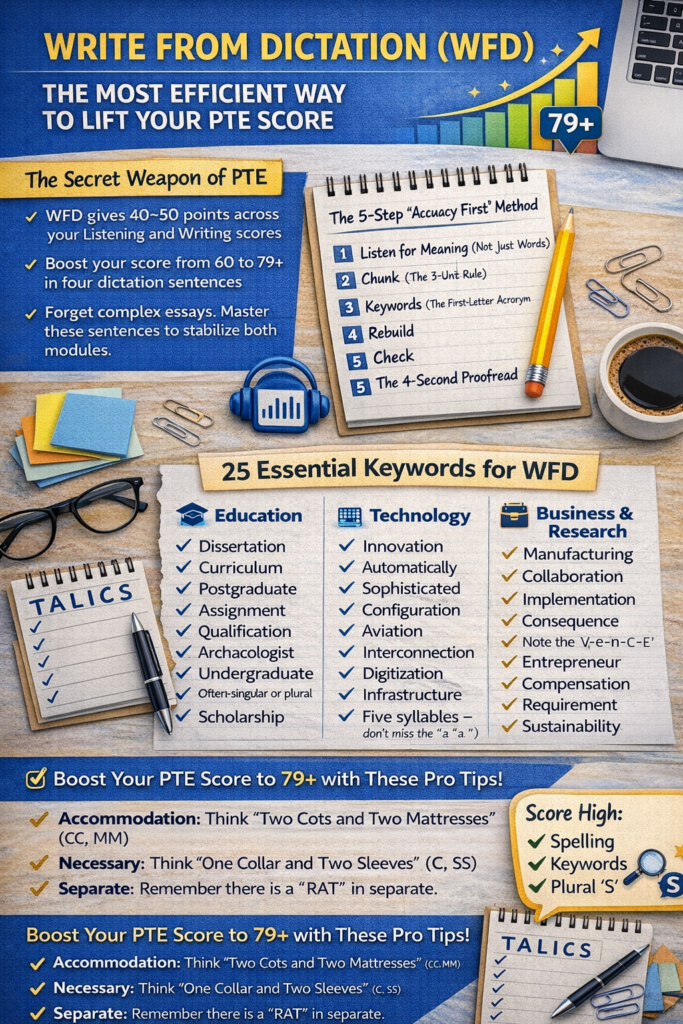
Because it is an integrated task, WFD provides roughly 40–50 points distributed between your Listening and Writing modules. Think about that: nearly half the points you need for a superior score are packed into just 3 or 4 short sentences at the end of the exam. If you master this task, you stabilize both sections. If you miss it, you miss your target.
The 5-Step “Accuracy First” Method
Don’t just “listen and hope.” To get a 79+ or 90, you need a repeatable system that works even when you’re tired at the end of the test. I teach my students this 5-step rhythm:
1. Listen for Meaning (Not Just Words)
The biggest mistake is trying to catch individual words as they fly past. Instead, listen to the message. If you understand what the sentence is actually saying, your brain will naturally “fill in” the smaller grammar words like the, a, or of later. Focus on the core idea first.
2. Chunk (The 3-Unit Rule)
A standard WFD sentence is about 8–15 words long. That is too much for most people to hold in their head word-for-word. Instead, break it into three logical “meaning chunks”:
-
Chunk 1: The Subject (Who or what is the sentence about?)
-
Chunk 2: The Action (What is happening?)
-
Chunk 3: The Detail (Where, when, or how?)
-
Example:[are required to submit][their assignments by Friday]. It is much easier to remember three ideas than twelve isolated words.
3. Keywords (The First-Letter Acronym)
Use your erasable notepad! Do not try to write out full words; you will fall behind and lose the end of the sentence. Instead, write the first letter of every word you hear.
-
Audio: “The university library is closed on Sundays.”
-
Your Notes: T U L I C O S.
4. Rebuild
Immediately after the audio stops, start typing the full sentence using your letters as triggers for your memory. Do this while the “echo” of the voice is still fresh in your mind.
5. Check (The 4-Second Proofread)
Before hitting “Next,” look for the “Points Killers.” Does the sentence start with a capital? Does it end with a full stop? Did you miss any plural “s” endings? This final check should take no more than 4 seconds to avoid overthinking.
25 Essential Keywords You Must Master
The PTE AI draws from a specific bank of academic and professional vocabulary. If you can spell these 25 words perfectly under pressure, you are already ahead of the curve.
Education
-
Dissertation: (Double ‘s’, single ‘t’)
-
Curriculum: (Double ‘r’)
-
Postgraduate: (One word, no hyphen)
-
Assignment: (Double ‘s’)
-
Qualification: (The ‘-fication’ suffix)
-
Archaeologist: (Note the ‘aeo’ combination)
-
Undergraduate: (Often singular or plural)
-
Scholarship: (Silent ‘ch’ sound)
Technology 9. Innovation: (Double ‘n’ in the middle) 10. Automatically: (The ‘-ally’ ending) 11. Sophisticated: (Think ‘ph’ for the ‘f’ sound) 12. Configuration: (Common in tech prompts) 13. Aviation: (The ‘v-i-a’ sequence) 14. Interconnection: (A favorite for complex sentences) 15. Digitization: (Watch the ‘z’ vs ‘s’ based on your regional choice) 16. Infrastructure: (Five syllables—don’t miss the ‘a’)
Business & Research 17. Manufacturing: (The ‘-uring’ suffix) 18. Collaboration: (Double ‘l’) 19. Implementation: (The ‘-ment’ ending) 20. Consequence: (Note the ‘u-e-n-c-e’) 21. Entrepreneur: (A very common spelling trap) 22. Compensation: (Think ‘pens’ like a pen) 23. Requirement: (Singular vs plural ‘s’ is common here) 24. Acquisition: (The silent ‘c’) 25. Sustainability: (Note the ‘i-l-i-t-y’ ending)
Your Routine: The Road to 90
Don’t cram for three hours on a Saturday. WFD is a “muscle memory” skill; it requires short, daily bursts of practice.
The 10-Minute Daily Drill
-
Minutes 1–8: Practice 10–15 WFD sentences on an AI portal. Do them under timed conditions to simulate the pressure.
-
Minutes 9–10: Note down your spelling mistakes. Write the correct version three times. This is how you “upload” the correct spelling to your brain.
The 45-Minute Weekly Deep Dive
-
Full Listening Mock (25 mins): Take a mock test that includes WFD at the very end. You need to practice this task when your brain is already tired from 30 minutes of other listening tasks.
-
Error Analysis (10 mins): Look at your misspelled words from the week. Are you missing double letters? Forgetting the silent ‘p’ in receipt? Identifying these patterns is the only way to stop repeating them.
-
Shadowing (10 mins): Listen to an academic podcast and try to repeat the sentences exactly as they are said. This builds your “echoic memory,” helping you hold sentences longer.
Final Pro-Tips: Spelling and The “S” Trap
One of the biggest heartbreaks is a student who hears the whole sentence but loses points for silly traps.
1. The “S” Trap (Plurals vs. Singulars) The AI scoring engine is obsessed with the letter “s.” If the speaker says “students” (plural) and you write “student” (singular), you lose points for that word. Listen specifically for that “hissing” sound at the end of nouns. If you are 100% unsure, some students add both versions (e.g., “student students”)—the AI currently gives credit if the correct word is present in the sequence, but it is better to listen for the verb agreement (e.g., “students are” vs “student is”) to be sure.
2. Mnemonics for Tricky Words Use “hooks” to remember the words that everyone else misses:
-
Accommodation: Think “Two Cots and Two Mattresses” (CC, MM).
-
Necessary: Think “One Collar and Two Sleeves” (C, SS).
-
Separate: Remember there is a “RAT” in separate.
Remember, in Write From Dictation, clarity is more important than speed. Keep your sentences clean, your spelling sharp, and your practice consistent. You’ve got this!