
The PTE Academic writing section is often the source of more cold sweats than any other part of the test. You see the prompt, the timer starts ticking down from 20:00, and suddenly your brain decides it’s a great time to forget every English word you’ve ever learned.
But here’s the secret: the PTE essay isn’t a test of your creative genius or your ability to write like Shakespeare. It is a test of your ability to follow a structure, use correct grammar, and manage your time under pressure. If you go into the room with a rigid plan, you don’t need to think; you just need to execute.
This guide will show you exactly how to dismantle the 20-minute timer and turn it into a manageable, step-by-step process.
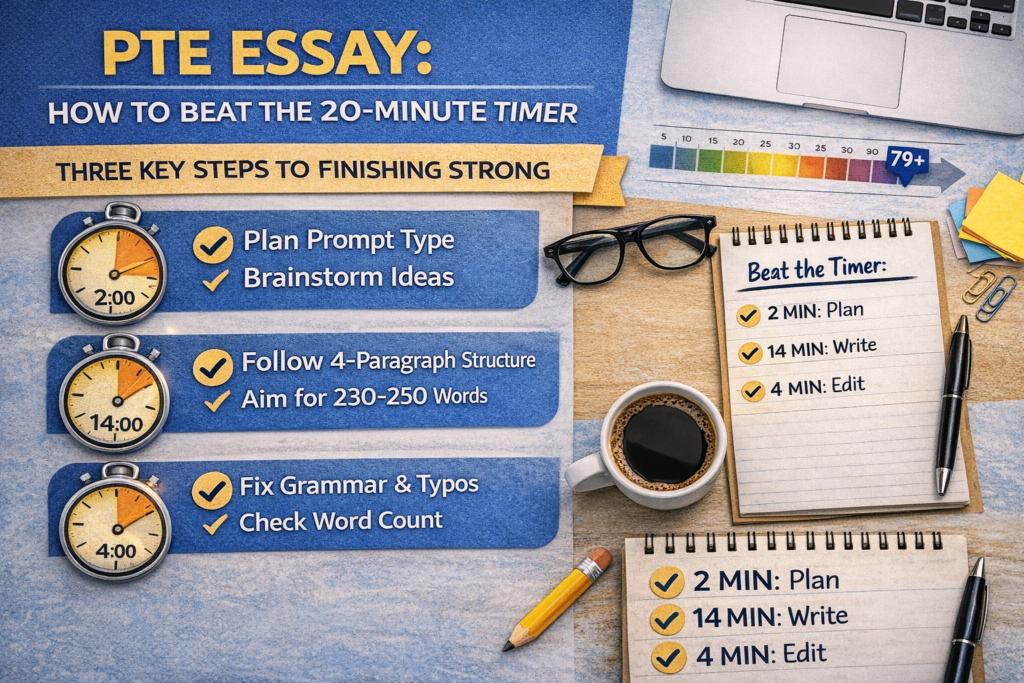
The Golden Time Plan: 2-14-4
Most students fail because they spend 18 minutes writing and 2 minutes staring at the screen in a daze. To score high, you must treat your time like a budget.
1. The 2-Minute Plan (Minutes 20:00 – 18:00)
Do not touch the keyboard yet. This is where most people panic and start typing “In the modern world…” before they even know what their second point is. Use these 120 seconds to:
- Identify the prompt type: Is it Agree/Disagree? Problem/Solution? Advantages/Disadvantages?
- Pick a side: Don’t sit on the fence. It’s much easier to write a strong essay if you pick one clear side.
- Brainstorm two ideas: You only need two main points. Jot them down on your erasable note board.
2. The 14-Minute Write (Minutes 18:00 – 04:00)
This is the “Drafting Phase.” Because you already have your two points, you aren’t “thinking” anymore—you are just “translating” those points into the 4-paragraph structure provided below. Your goal here is to hit the 200–300 word count. Aim for about 230–250 words to be safe.
3. The 4-Minute Edit (Minutes 04:00 – 00:00)
This is the most important phase. The PTE is scored by an AI. The AI is much better at spotting a missing comma or a misspelled word than it is at judging the “depth” of your soul. Use these four minutes to hunt for “S” errors (pluralization/subject-verb agreement) and typos.
The 4-Paragraph Structure
To keep your structure airtight, use this four-block method. Each paragraph has a specific job.
Paragraph 1: The Introduction (30–45 words)
Keep this short. You just need to paraphrase the prompt and state your opinion.
- Sentence Starter 1 (Background): “In recent years, the issue of [Topic] has become a matter of intense debate among experts and the general public.”
- Sentence Starter 2 (Thesis/Opinion): “This essay will argue that [Your Opinion] is beneficial/detrimental due to several key factors.”
Paragraph 2: First Main Point (80–100 words)
Explain your first reason and give a (made-up) example.
- Sentence Starter 1 (Point): “The primary reason why I believe [Opinion] is that [Reason 1].”
- Sentence Starter 2 (Example): “For instance, a recent study conducted by the University of Cambridge revealed that [Example Supporting Reason 1].”
Paragraph 3: Second Main Point (80–100 words)
Add a second, different reason to reinforce your stance.
- Sentence Starter 1 (Point): “Furthermore, another significant aspect to consider is [Reason 2].”
- Sentence Starter 2 (Result): “As a result, it is clear that [How Reason 2 leads to your opinion].”
Paragraph 4: The Conclusion (30–45 words)
Summarize everything. Do not add any new information here.
- Sentence Starter 1 (Summary): “In conclusion, although some might argue otherwise, the evidence suggests that [Restate Position].”
- Sentence Starter 2 (Final Thought): “Therefore, it is highly recommended that [Final Recommendation/Prediction].”
What NOT to Do: The “Complexity Trap”
Many candidates think that using “big words” will get them a higher score. In the PTE, this is often a recipe for disaster.
1. Avoid Overcomplicated Vocabulary If you use the word “supercalifragilisticexpialidocious” but use it incorrectly, the AI will penalize you. It is better to use “helpful” correctly than “advantageous” incorrectly. Stick to words you are 100% sure about.
2. Avoid Long, “Snake-like” Sentences Do not write sentences that are 40 words long. When you write very long sentences, you are much more likely to lose control of your grammar and punctuation. Aim for a mix: some short, punchy sentences and some “complex” sentences (using words like because, although, or while). If a sentence takes up three lines of text, break it in half.
3. Don’t Try to Be Original The computer doesn’t care if your ideas are boring. If the prompt is “Should children have cell phones?” and you say “Yes, because they can call their parents in an emergency,” that is a perfect, high-scoring point. You don’t need a revolutionary philosophical argument; you just need clear, logical English.
Sample Thesis Statements & Conclusion Lines
Sample Thesis Statements
- Topic: Remote Work
- “This essay will contend that while working from home offers flexibility, the lack of face-to-face interaction can lead to a decrease in long-term productivity and team cohesion.”
- Topic: Environmental Protection
- “I strongly believe that governments should prioritize renewable energy investments over fossil fuel subsidies to mitigate the irreversible effects of global climate change.”
Sample Conclusion Lines
- Ending with a Prediction: “Ultimately, if society fails to address this issue now, the consequences for future generations will likely be severe and widespread.”
- Ending with a Recommendation: “On the whole, it is evident that a balanced approach, combining technological innovation with strict regulation, is the most effective way forward.”
The Mini “Final 4” Editing Checklist
When the clock hits 4:00, stop writing. Even if you are in the middle of a brilliant sentence, stop. Move to this checklist:
- The “S” Check: Look at every verb. Does it match the subject? (e.g., “He walks,” not “He walk.”) Look at every noun. Should it be plural? (e.g., “Many students,” not “Many student.”)
- The Capitalization Check: Does every sentence start with a capital letter? Are “I”s capitalized? Are proper nouns (like “Australia” or “London”) capitalized?
- The Punctuation Check: Did you put a space after every comma and period, but never before? Did you end every paragraph with a period?
- The Word Count Check: Is your count between 200 and 300 words? If you are at 190, add one more “For example…” sentence. If you are at 310, delete your most complicated sentence.
By following this 2-14-4 plan and sticking to the structure, you take the “luck” out of the PTE. You aren’t hoping for a good day; you are following a system that works every time.