
If you’ve ever reached the last few questions in PTE Reading and thought, “I definitely read that… but I can’t find it now”, you’re not alone. Most students I work with in Australia don’t struggle because their English is “bad.” They struggle because Reading is a timing game—and the test is designed to pull you into traps like long options, similar meanings, and sneaky keywords.
The good news: you don’t need to read faster like a robot. You need a method that helps you find what matters quickly and avoid spending 90 seconds deciding between two similar answers.
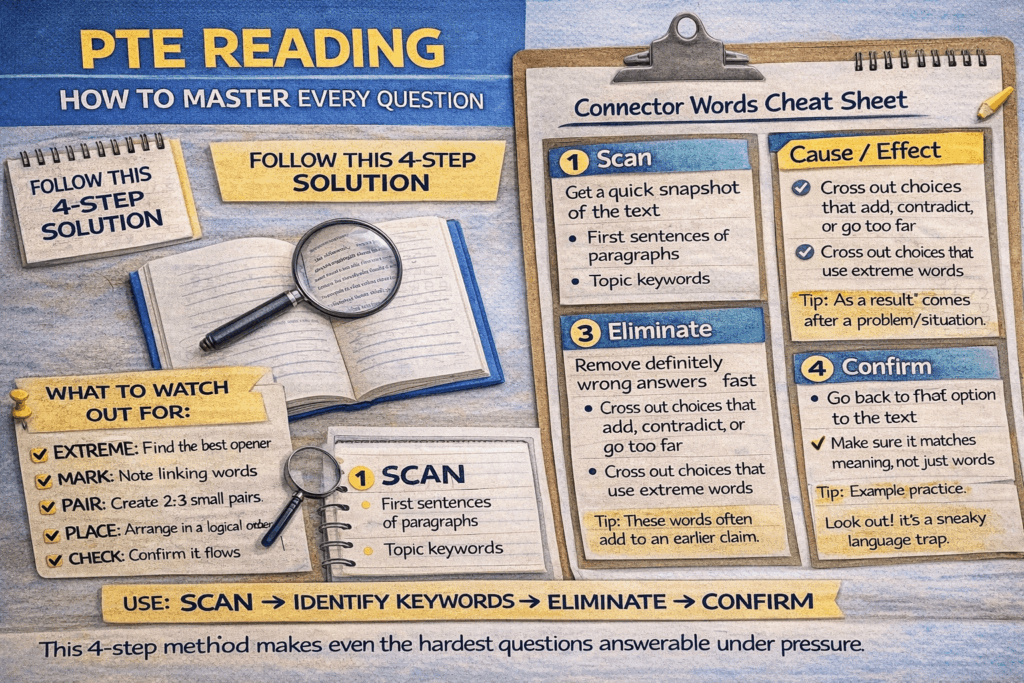
Here’s a simple 4-step method I teach to students aiming for 65–79+:
Scan → Identify Keywords → Eliminate → Confirm
It’s fast, repeatable, and most importantly… it stops you from guessing.
Why PTE Reading Feels So Hard (Even When You Understand English)
PTE Reading questions often feel unfair because the options are written to sound “almost correct.” You’ll see:
-
two choices with the same meaning but one is slightly too strong
-
a choice that matches one sentence but contradicts the main idea
-
a word in the option that changes the meaning (like always, only, never)
What I see students do wrong most often is this:
They read the whole passage carefully before looking at the question. That burns time and doesn’t actually increase accuracy.
Instead, you want to read with a purpose.
The 4-Step Method
Step 1: Scan (10–15 seconds)
Scan does not mean speed-reading every sentence. It means getting the structure of the text:
-
What is the topic?
-
Is it an argument, explanation, or comparison?
-
Where are the key sections (first paragraph, middle evidence, conclusion)?
How to do it quickly:
-
Read the first sentence of each paragraph
-
Notice repeated words (these are usually the topic keywords)
-
Ignore examples and details for now
This step gives you a mental map so you don’t feel lost later.
Step 2: Identify Keywords (in the question + options)
Now look at the question and highlight mentally:
-
names, dates, numbers
-
cause/effect words (because, therefore, leads to)
-
contrast words (however, although, whereas)
-
extreme words (always, never, only, must)
Also identify the keywords in each option, not the whole option.
Why? Because options are often long to distract you.
A strong keyword focus saves a huge amount of time.
Step 3: Eliminate (kill wrong answers fast)
This step is where you gain time.
Instead of asking “Which one is correct?”, ask:
Which ones are definitely wrong?
Eliminate options that:
-
add information not in the text
-
use extreme language when the text is more balanced
-
reverse cause and effect
-
contradict a key point
-
are too general or too specific compared to the passage
Your goal is to reduce to 2 options quickly.
Step 4: Confirm (match the final option to the text)
Only after eliminating do you confirm. This is the step many students do too early.
To confirm:
-
go back to the exact sentence/section in the text
-
check meaning (not just matching words)
-
verify that the option matches the author’s point, not a random detail
If you can find one clear supporting line or idea, you’re safe.
Mini Example: Keyword Elimination (2–3 sentences)
Question: What is the writer’s main point about online learning?
Option A: “Online learning is always more effective than classroom learning.”
Option B: “Online learning can be effective when designed well and supported.”
If the passage says online learning works in some cases but depends on design and support, eliminate Option A immediately because “always” is too extreme. Option B matches the balanced language and is more likely correct.
That’s elimination in action.
Common Mistakes (What I See Students Do Wrong)
Here are the biggest mistakes that waste time and lower scores:
-
Reading every word of the passage before even checking the question
-
Getting stuck between two options because you’re trying to “feel” the answer
-
Not noticing extreme words like always, never, only, must
-
Choosing an option because it uses the same words as the passage (keyword trap)
-
Spending too long on one question and panicking later
-
Changing a correct answer because another option “sounds nicer”
-
Forgetting to confirm with the passage and relying on memory
If you fix just two of these—extreme word awareness and elimination first—you’ll feel the time pressure drop immediately.
A Fast Daily Practice Plan (15 Minutes)
You don’t need hours every day. Consistency beats long study sessions.
Here’s a simple 15-minute plan you can do daily:
Minutes 1–3: Scan Practice
Pick any short article (news, blog, Wikipedia).
-
Read first sentence of each paragraph
-
Say out loud: “This paragraph is about ____.”
Minutes 4–8: Keyword + Elimination Drill
Take 3 multiple-choice questions (or create your own from the article).
For each:
-
underline 2–3 keywords
-
eliminate at least 2 options fast
-
don’t allow yourself more than 90 seconds per question
Minutes 9–12: Confirming Practice
For each correct answer:
-
find the exact line that supports it
-
if you can’t find it quickly, your approach needs tightening
Minutes 13–15: Review Mistakes
Write quick notes:
-
“I got trapped by wording like ____.”
-
“Next time I’ll look for ____.”
This small review is where improvement actually happens.
Final Tip: How to Manage Time on Test Day
If a question is eating time, don’t fight it.
A good rule:
-
If you can’t eliminate anything in 30 seconds, mark your best choice and move on.
Many high scorers don’t get every question perfect. They win by keeping control of time and not panicking.
Try This Method in a Full Mock Test (Friendly Suggestion)
The 4-step method feels easy when you read about it—but it becomes powerful when you use it under real timing pressure. If you haven’t done a full mock test recently, try one this week and practise:
-
scanning quickly
-
keyword spotting
-
elimination before confirming
Even one proper mock + review session can reveal exactly where you’re losing time.